Cold chain logistics is not only about knowing where an asset is. Companies also need to know whether the asset has remained within the required temperature conditions throughout storage and transportation. A shipment can arrive at the correct destination while still being compromised by an unnoticed temperature change.
This is where active RFID tags with temperature sensor technology can add another layer of visibility. By combining asset identification with temperature monitoring, companies can track both the location and condition of temperature-sensitive assets. RSTC’s 2.45 GHz active RFID range includes the RS-AT11, which combines active RFID communication with temperature sensing for applications requiring asset identification and temperature monitoring.
How Does RFID Cold Chain Tracking Work?
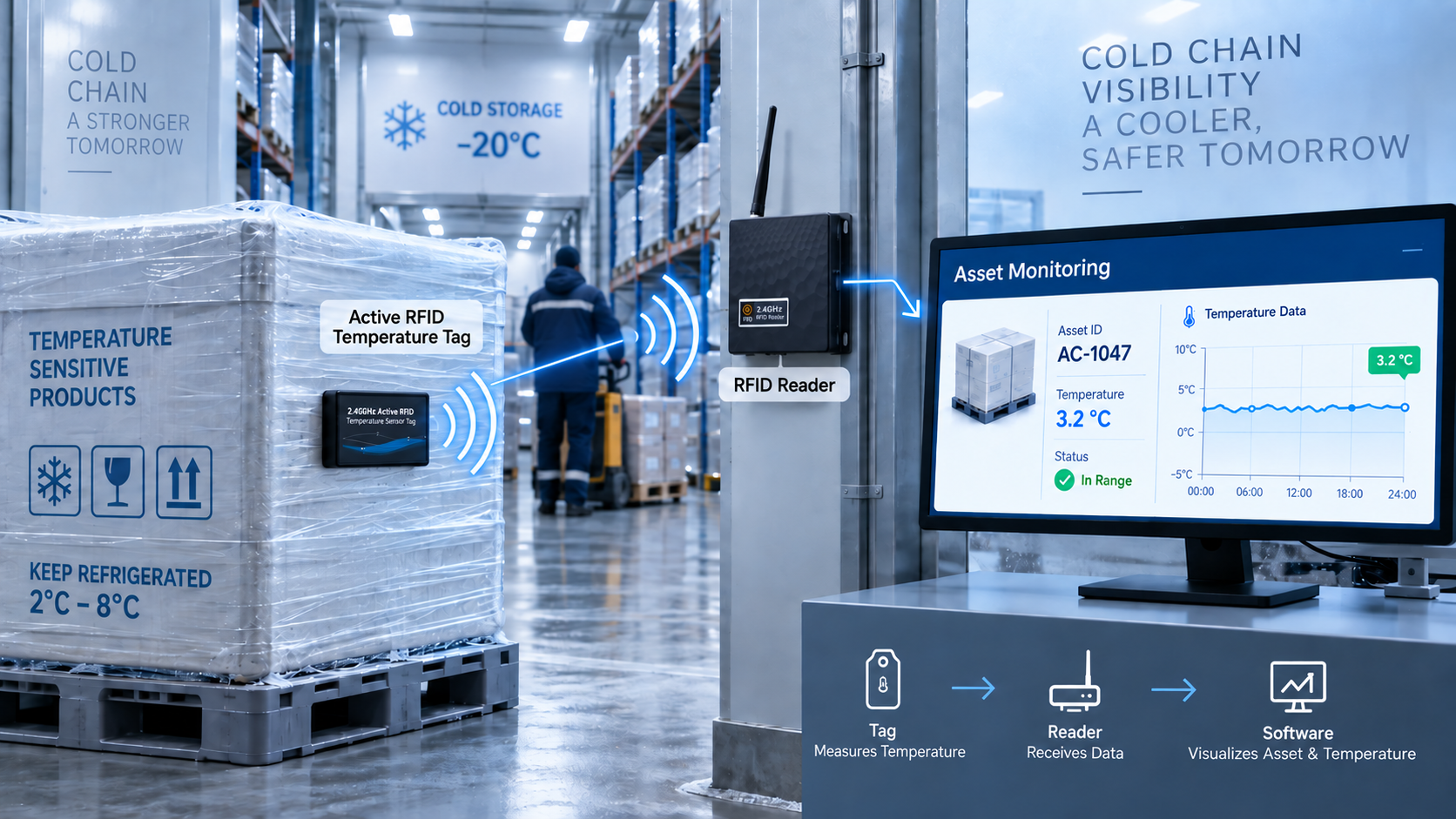
RFID cold chain tracking combines active RFID temperature tags, compatible readers, and software to associate an asset’s identity with temperature data. The tag collects temperature information and transmits its ID and monitoring data within the configured reader coverage area.
Unlike passive RFID tags, active RFID tags contain their own power source and can transmit at preset intervals. This makes them suitable for applications that require repeated updates, longer-range identification, or additional sensing capabilities.
For a broader comparison of the two technologies, see our guide to active vs. passive RFID systems.
What Data Can an Active RFID Temperature Tag Provide?
An active RFID temperature tag can associate an asset identifier with temperature measurements. In the RS-AT11, the RFID tag provides an 8-byte basic ID, while the PT100 sensor collects temperature data. Its sending interval is listed as one transmission per second and can be customized for different applications.
Why Use Active RFID Temperature Tags for Cold Chain Tracking?
Active RFID temperature tags are useful when a project requires both asset identification and repeated temperature monitoring across storage, handling, and transportation.
What Cold Chain Monitoring Challenges Can Active RFID Temperature Tags Address?
One practical benefit is earlier visibility into temperature changes. Manual inspections may only provide a snapshot of an asset’s condition, while an active RFID temperature tag can transmit temperature data at configured intervals.
For example, consider a temperature-sensitive container moving between a cold storage facility and a distribution center. If the container experiences an unexpected temperature change during handling, regular monitoring can provide information that would otherwise be difficult to obtain.
This does not automatically prevent a temperature excursion. Instead, it gives operators more information to identify abnormal conditions and investigate what happened.
Where Can Active RFID Temperature Tags Be Used?
The technology can be applied to a range of temperature-sensitive assets and monitoring environments, including cold chain logistics, medical storage, food transportation, and other applications where temperature monitoring is required.
RSTC specifically lists environmental monitoring and cold chain logistics among applications for its sensor-enabled active RFID tags.
Common application scenarios and key deployment considerations include:
Application Scenario | What Can Be Monitored | Key Consideration |
Cold storage | Asset ID and temperature | Reader coverage and sensor position |
Food transportation | Container or pallet condition | Transmission interval and vehicle environment |
Medical storage | Temperature-sensitive assets | Required temperature range and data records |
Distribution centers | Asset movement and condition | Reader placement at transfer points |
RSTC RS-AT11 Active RFID Temperature Tag
The RS-AT11 combines 2.45 GHz active RFID communication with an external PT100 temperature sensor for applications requiring both asset identification and temperature monitoring.
How Does RSTC’s RS-AT11 Monitor Temperature?
The external sensor can measure object or environmental temperature, while the active RFID tag transmits identification and temperature data to compatible readers within the configured tracking area. This allows temperature information to be associated with the correct asset record for monitoring and follow-up.
The RS-AT11 operates at 2.4–2.48 GHz and has a listed reading distance of more than 80 meters in an open environment. Its temperature measurement range is 0 °C to +210 °C, using a PT100 platinum resistance temperature sensor.
RS-AT11 Key Specifications
Specification | Value |
Operating Frequency | 2.4-2.48 GHz |
Reading Distance | >80 m, open environment |
Measurement Range | 0 °C to +210 °C |
Sensor Type | PT100 |
Sending Interval | 1 second/time, customizable |
Dimensions | 55 × 58 × 20 mm |
Working Temperature | -30 °C to +70 °C |
Installation | Sewing / Insert |
Note: The sensor measurement range and the tag’s operating temperature are separate specifications and should both be checked against the actual application requirements.
How to Build a Reliable RFID Cold Chain Tracking System
A complete RFID cold chain tracking system typically includes the temperature tag, compatible readers, and tracking software. The tag collects identification and temperature data, readers receive the wireless signals within defined tracking zones, and software associates the data with the corresponding asset record.
Active RFID Tag → RFID Reader → Tracking Software → Temperature Data → Operator Action
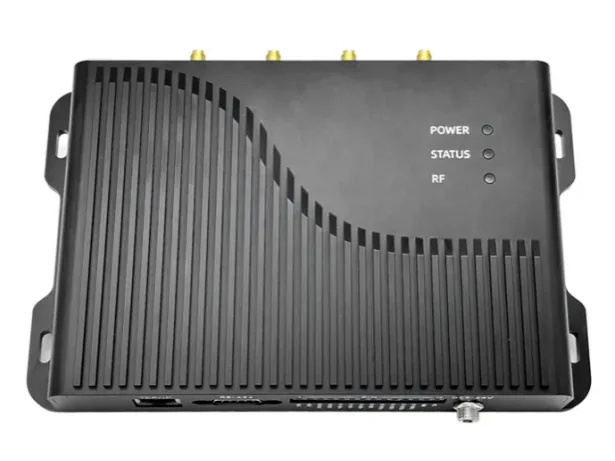
RSTC offers 2.45 GHz active RFID readers in different configurations for fixed and mobile tracking environments, allowing the reader setup to be matched to different application requirements.
How to Choose an Active RFID Temperature Tag
The right tag depends on more than temperature measurement. Key selection factors include temperature range, sensor type, read range, transmission interval, installation method, operating environment, battery requirements, and reader coverage.
Temperature Range and Sensor Type
The required measurement range should match the expected temperature conditions of the monitored asset. Sensor type also matters because the sensing element may need to measure the temperature of the surrounding environment, a container, equipment, or a specific surface. For applications using an external probe, both probe placement and the tag’s operating limits should be evaluated.
Read Range and Reader Coverage
Read range should be evaluated together with reader placement and the physical tracking area. A longer listed reading distance does not automatically mean better system performance. Warehouses, vehicles, containers, walls, metal surfaces, and other environmental factors can affect communication, so coverage should be verified in the actual deployment environment.
Transmission Interval and Battery Life
A shorter transmission interval provides more frequent updates, but it can also increase power consumption. A longer interval may reduce energy use when the application does not require continuous updates.
The RS-AT11 has a listed one-second sending interval that can be customized according to monitoring frequency and battery requirements.
Installation Method and Probe Position
Installation location can affect the quality and usefulness of temperature measurements. The tag may be installed on containers, equipment, packaging, or other assets depending on the application.
The RS-AT11 supports sewing or insert installation. RSTC also lists a 30 cm probe wire and a customizable wire length and probe type, which can be useful when the sensor needs to be positioned separately from the main RFID tag body.
When Does Active RFID Make the Most Sense for Cold Chain Tracking?
Active RFID becomes particularly useful when a project requires longer-range identification, repeated wireless transmission, and additional sensing capabilities.
Tracking Requirement | Potential Approach |
Basic item identification | Passive RFID may be sufficient |
Larger tracking areas | Active RFID may be considered |
Asset identification + temperature | Active RFID temperature tag |
Frequent temperature updates | Active RFID + sensor + reader system |
Active RFID is not the best choice for every RFID project, but it may be suitable when longer-range identification, repeated wireless transmission, and temperature sensing are required together.
Before deployment, the tag, reader, sensor position, and software workflow should be tested in the intended environment. RSTC also provides application testing, product selection support, customization, and system integration assistance based on specific project requirements.
Conclusion: Improving Cold Chain Visibility with Active RFID Temperature Tags
Active RFID temperature tags can support cold chain projects that require both asset identification and repeated temperature monitoring. Their value depends on selecting the correct sensor range, transmission interval, reader coverage, installation method, and software workflow for the application.
RSTC’s RS-AT11 combines 2.45 GHz active RFID communication with an external PT100 temperature sensor for applications that fall within its specified operating and measurement conditions.